Eve Connor
Eve Connor was a WORK Records volunteer researching the Robinson and Sons archive at Derbyshire Record Office. A writer and workshop facilitator based in the Midlands, five of her plays have been produced by the University of Cambridge, where she graduated with a BA (Hons) in English. Eve is pursuing an MSt in Creative Writing from the University of Oxford.
A life-long curiosity for things and the stories behind them lies at the heart of my creative practice. It was this love, as well as my involvement at university with several dozen brilliant and bonkers amateur theatre-makers, that drew me to the ephemera of the Robinson’s Amateur Operatic and Dramatic Society. This was the starting point. But my research soon surpassed personal nostalgia to reveal a workplace club beloved and preserved by its membership in a hugely touching way: an organisation that spanned a century, united company directors and apprentices under one curtain call, rented chandeliers, and, one vigorous year, even achieved a ‘Hunting Horn’ budget!
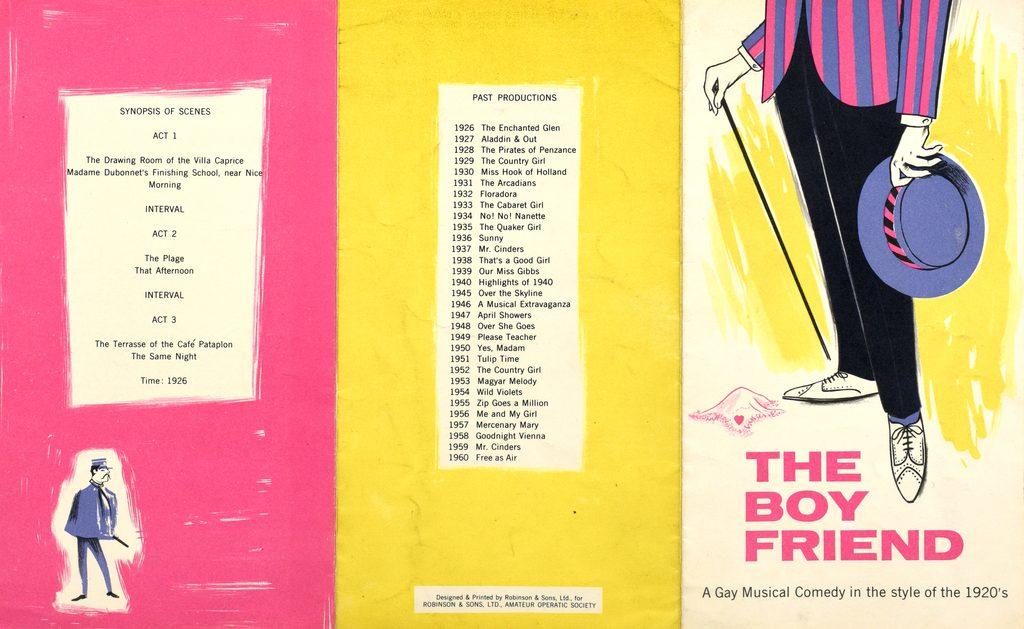
In the 1920s, the future Mayor of Chesterfield, Florence Robinson, founded the Robinson’s Amateur Operatic and Dramatic Society. The initial membership was largely female, reflecting the demographic of the wider Robinson and Sons Ltd workforce. In 1924, women paid an annual subscription of sixpence, whereas male members were expected to fork out one whole shilling. But by 16 December 1956, an entry in the Society’s minutes book noted committee members had been “asked to encourage more men to join the society.” Elegant cursive had seceded to the typewriter; there had been a world war. Times were changing and so were the programmes.
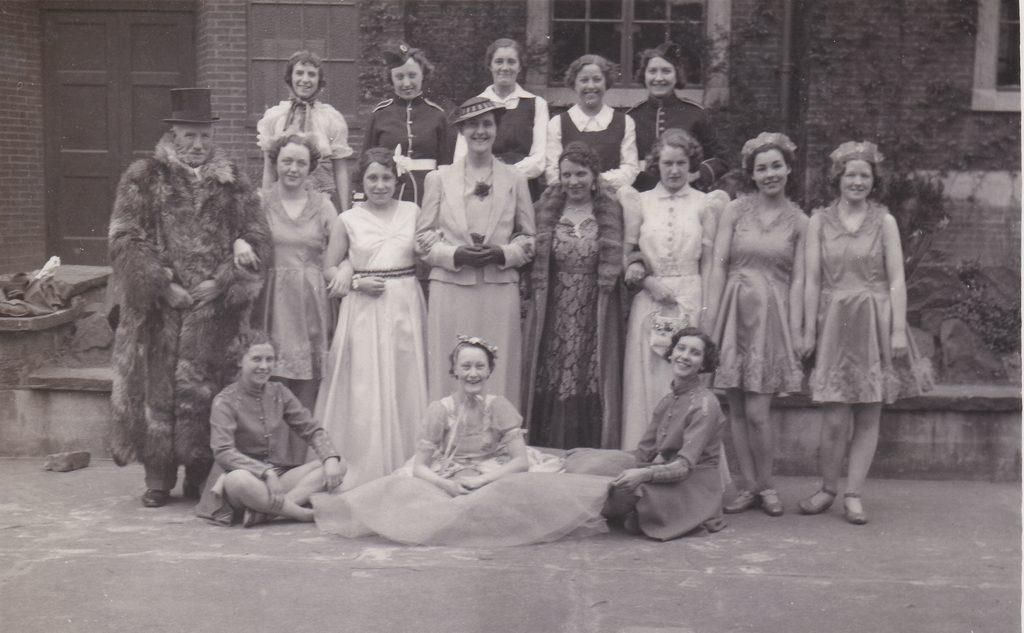
Of the extensive Robinson’s archive at Derbyshire Record Office, the Society contributes to seven bundles. My research prioritised four: minute books dating from between 1927-1980, ‘Assorted items relating to productions’ and ‘Programmes of productions, 1929-1983’. The last is by far the largest and its contents tells its own story. Programmes that had once been simple affairs — a show’s title stamped onto plain paper booklet no larger than a standard envelope — evolved from the 1950s into colourful and customised mementos.
Anniversaries were special occasions celebrated by multi-page booklets, complete with cast photographs, advertisements for local firms, and, sometimes, in the case of the programme for the 25-year anniversary show ‘Tulip Time’, a poem written by then-president, Victor Robinson. Warm sentiment shines through:
As President of our Society, I have the privilege,
After Twenty-five years’ operatic-ing,
Of saying how much we owe
To those
Who’ve played their part in all of any of our shows.
What fun it’s been! What pleasure!
And what laughter,
What scenes behind the scenes! What tunes we’ve had!
“May they live happy now and ever after
The Operatic lassie and her lad.
Twenty-five years. What sweet romances,
How many smiles, how many songs and dances
Have been produced, as well as sons and daughters
Now in the show. What joy all this has brought us,
And others too. So we can be emphatic—
CONGRATS TO ALL IN ROBBO’S OPERATIC.
In 1965, the Society originated the role of Publicity Officer to capitalise on developments in advertising technologies. While, in 1924, the ‘means of advertisement’ had been modern enough to include a ‘Screen at the Picture Houses’, most of the spending relied on ‘making use of various conveyances belonging to the firm’ or on ‘Sandwich men.’ By 1967, the Society had extended their marketing not only to encompass an ‘Announcement on BBC Northern Events’, but a new and distinctly bourgeois product, one that was entering British homes at an unprecedented rate due to post-war economic growth. The Society ordered ‘100 Car Stickers’.
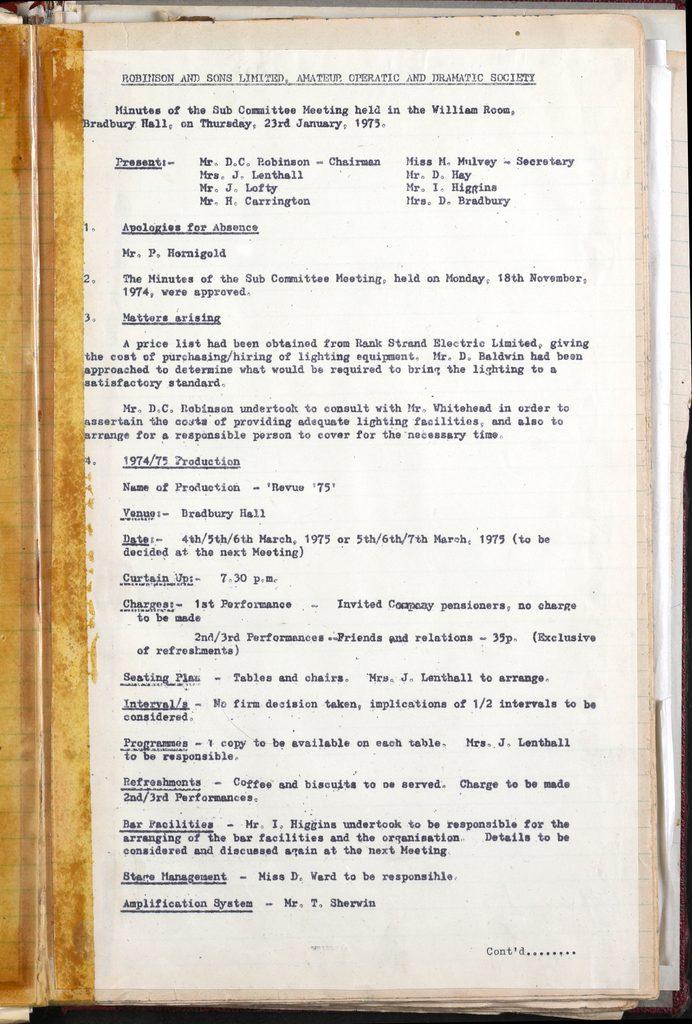
A closer look at the two minute-books further attests to the ambition behind the Society. From the beginning, actors are referred to as ‘the artists’ and provided with ‘lemon water […] during the interval’; enquiries are made “regarding an instructor with a view to holding an Elocution Class”and, many decades later, bookings are placed for courses with the British Drama League, to be attended by the Society’s stage manager, electricians and wardrobe mistress.
In 1973, the Society was “congratulated on being so ambitious as to produce a show which has never been performed by professional actors, ‘Viva Mexico’ having been written especially for amateurs.” It was an unorthodox decision, dependent on the Society’s reputation to pull in the punters instead of banking on a show’s pre-existing commercial appeal. The choice implies a certain confidence. However, just one year later, the Three-Day Week restrictions on electricity enacted by the British government hit Chesterfield. The Society Chairman urged resilience in that year’s programme: “I am sure none has suffered so much as the Operatic Society. Despite cold rooms, changed venues for rehearsals and other deprivations, the show goes on.”
Behind-the-scenes, however, financial uncertainty concerned the committee. “[I]n view of the General economic situation through the country,” the minutes book reports, “the Directors considered that it was wise and prudent for the Company not to subsidise the proposed 1975 Production.”
It was a tough blow. Any show organised by the Society that year would have to be self-financed by its members. But as the scale of performance adjusted to these restraints — transitioning from full-scale musicals to evenings of ‘light entertainment’ and revue shows — the Society’s ambition refused to cease. Instead, it redirected. It innovated.
Former Robinsons’ employee, Josie Walker, spoke at the WORK Records roundtable about her experiences joining the Society during this period. "We all loved those evenings,” Josie said, “it was a mix of dancing and singing with duets and solos, tap dancing, comedians, magicians, and always a chorus line to start with, dressed in black leotards, fishnet tights, top hat, and canes.”
The Society membership, though dwindling in number and obliged to accept non-Robinson’s employees to make up their ensemble cast, took ‘our show on the road’ to community centres, pensioners’ parties, and church halls. “In one whole year, we visited 35 venues, and that was true.” In a full circle moment, many of the care home residents the Society visited had themselves worked at Robinson’s before their retirement.
These travelling entertainments continued throughout the 1980s, the decade of the pantomime. A Derbyshire Times clipping describes one of the highlights of the Society’s 1983 production as “a dance routine to the pop hit ‘Fame’, featuring a line-up of mini-skirted girls.” Never ones to rest of their laurels, the Society continued to respond to the trends of the day. The very last entry in the minute books archived at Derbyshire Record Office, written in the same year as the closure of the Robinson’s Holmebrook Works in Chesterfield, suggest a Society still striving: “It was reported that the production of ‘Aladdin’ was the best choice for 1981, ‘Aladdin’ being considered to be a pantomime which might itself give a little more scope…”
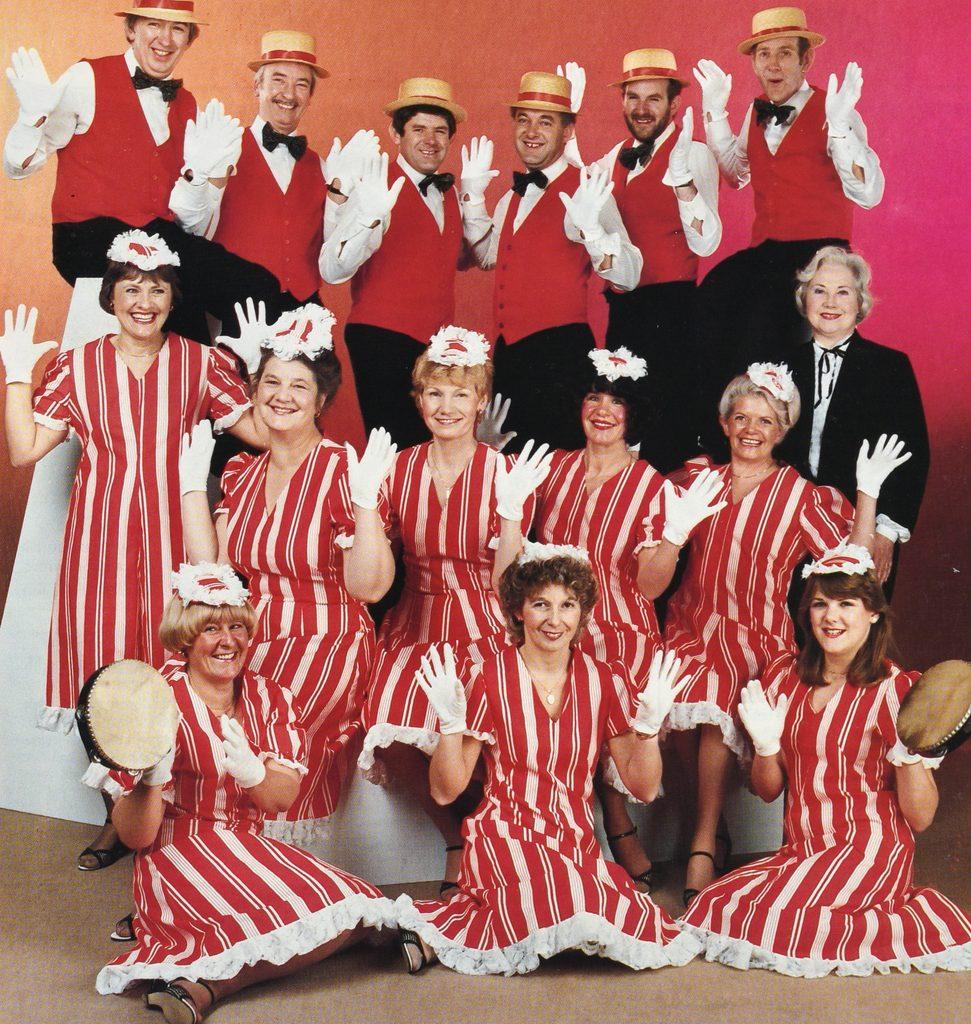
Through volunteering with WORK Records, it has been my pleasure to play a small part in preserving the history of the Robinson’s Amateur Operatic and Dramatic Society. It was not until listening to Josie that I learned I was researching an ongoing history. The remaining Society members regularly dine at a pub in Chesterfield,
…in a private room, still singing between eating. This is our time when we always reminisce over the many years of entertaining, laughing at all of the funny bits and especially the unintended mistakes — and with an average age of 86 (Martin excepted) just wish we could do it all over again because it was our life…
Beginning the WORK Records project, I had been delighted by the material legacy of the Society: programmes, posters, notebooks, careful newspaper clippings, and photographs tucked into old, cream envelopes. Untying the string around the parcels carted up from the Record Office stores always gave me a thrill. On multiple occasions, other volunteers messaged me to say they had spotted a rehearsal photograph in the Chesterfield Library collection or a call-out for singers in the Robinsons staff magazine, ‘The Link’.
Reflecting on the process, I cannot help but recognise the contrast between all this stuff, the physical records, and the intangible quality of today’s digital world, where few memories can be held in our hands. I wonder what we will leave behind. In one hundred years, if the internet vanished, what would archivists have to imagine us with? I will carry much of the WORK Records project forward with me — the relationships, the skills and the knowledge — but it is the material and the physical, and the importance of these, that I feel more confident than ever setting at the heart of my practice. The show must go on. Let’s make sure it’s remembered!