Sandra Maycock
Sandra Maycock has been a volunteer with the John Smedley Archive for eight years. A former primary school teacher, she was drawn to Smedley’s by her interest in the history of knitwear and her long‑standing hobby of hand‑spinning and knitting her own yarn from raw sheep fleece. Sandra lives in Crich, a village high above the Derwent Valley on the edge of the Peak District.
As part of my volunteering with the John Smedley archive, I was very lucky to benefit from the expertise of the late John Mumby - a greatly respected and skilled colourist who worked with Smedley’s for years (from 1979 to 2008) and who, on retirement, joined our volunteer team and generously shared his knowledge, understanding and skills.
It was John who taught me the basic techniques of colour blending, and he had a wealth of knowledge about different fibres and their structures, and about the company’s history, how garments were made and who worked there. Although John died in 2024, we were able to record a fascinating interview with him from 2019 and it felt appropriate to include his influence as part of my WORK Records research – and there’s certainly a ‘thread’ that will emerge as you read on.
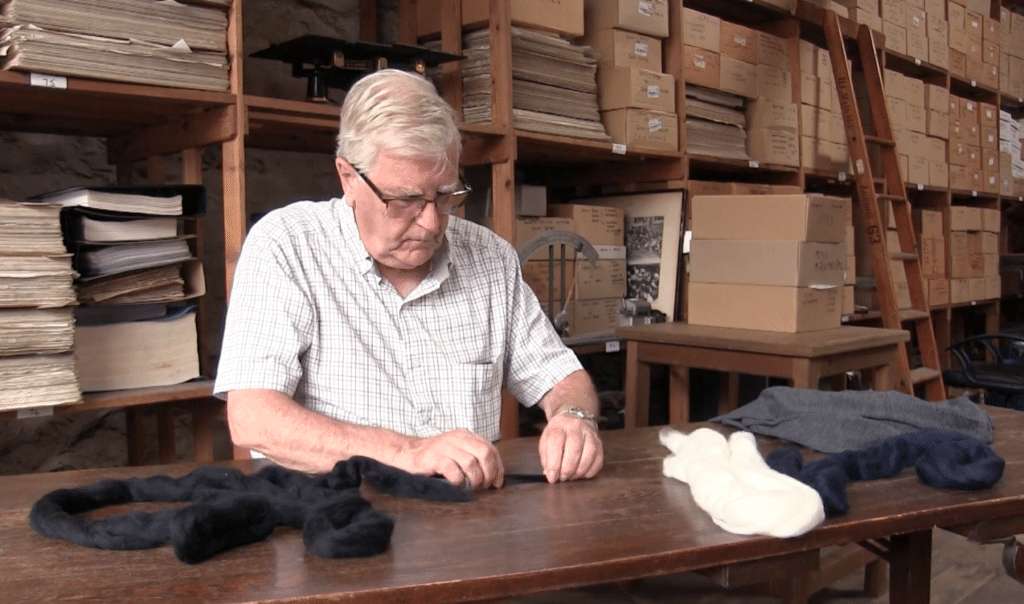

Watch videos of John Mumby demonstrating colour blending in the WORK Records SCREENING ROOM.
For WORK Records, I interviewed two fellow volunteers - Iris Smedley and Tony Wetton – both of whom worked at Smedley’s for many years and later returned as volunteers returning their retirement. In talking with them, I was able to find out more about working life at the company and about some of transitions that took place.
Iris (no direct family connection) started work in the spinning department at Smedley’s in 1960, aged 16. She operated coning machines, transferring yarn from ‘cops’ (tubes tightly wound with wool) onto uniform cones that were fed into twisting machines to ply two or more yarns together. Iris recalled that Smedley’s still relied on the traditional mule machines to produce cops in those days - long, noisy (and sometimes dangerous) frames that travelled back and forth as they worked
After four years, Iris left to have children, but she wasn’t away from work long, as when the children were toddlers, she was able to return to work on the evening or twilight shifts (either 4pm to 10pm, or 6pm-10pm) – something that was familiar to both Tony and I, who’d both had mothers working the evening shift at other firms to fit in around family life. When her children started school, Iris left her evening job and enrolled in college to learn shorthand and typing, coming back to work at Smedley’s in the Personnel Department, where she maintained employee and company records, operated the telephone switchboard on occasion, and typed up correspondence using a manual typewriter than can still be fund in the archive today.
Iris recalls how much her job changed in just seven years with the introduction of office computers. Despite being sent to Chesterfield College to learn word processing, the drastic change that came with computerisation found typists surplus to requirement, prompting Iris to briefly leave Smedley’s for a job at an architect’s office. It wasn’t long before the Personnel Manager at Smedley’s rang her, asking if she would like to come back, and of course she did!
Later on, Iris worked in John Smedley’s factory shop, selling garments to employees, the public and even a few celebrities. With an impressive knowledge of the garments and the company, Iris has worked with Smedley’s for over 40 years - not including her time volunteering in the archives where she now works alongside other volunteers, stitching accession labels into garments, transcribing letters and taking on a multitude of unexpected tasks.
As Iris was starting out in her career, Tony was leaving school, aged 15. He’d been unsuccessful securing a job at a local dye works and so his mother, who was working in Smedley’s canteen, brought him to the factory to ask if they would give him a job and he was granted a trial. With a wry smile Tony reflected: “You could say I started work at Smedley’s when I was ten. On school holidays, if there was no one to look after me at home, I came with me mum when she worked in the canteen”. When asked if he enjoyed going to work his reply was a firm “No, she got me washing up, and I wasn’t on the books, but I did get fed”
Tony’s first official paid job at Smedley’s was in the Bobbin Department – a precursor to yarn spinning - where most of the new, young people started out. Both Tony and Iris mentioned sitting on stools, learning to tie the tiny, neat weaver’s knots used to ply fine yarn onto bobbins and repair a broken warp threads in weaving. As a ‘bobbiner’, Tony remembers taking wool off a roving machine and storing it in the ‘damp house’ where yarn would be kept in good condition prior to further processing.
Tony was about 18 years old when he moved into spinning, this time working at a similar job to Iris on the ‘drawing’ machines, which by then had replaced the mules. Here, he ‘doffed’ the cops when they were full, loading them onto trolleys and creating joining yarns by ‘gatoring’ any broken ends. Once ‘doffed’, the cops were put through a conditioning machine and sprayed on a conveyor belt to maintain moisture levels before being put into big, square baskets ready for the next process.
Interestingly, I found some of the terminology used for these industrial processes is the same for hand spinning, such as colour blending fibres. At home, I use a drum carder to smooth out and draw fibre across bent, metal ‘tines’ which I then ‘doff off’, with a metal rod or metal knitting needle to break the continuous fibre round the drum. I can then ease it off the tines and roll or fold the fibre into a ‘batt’. The batt then gets drawn or drafted to thin it out as I spin into a ‘singles’ on a bobbin. When two bobbins are full of yarn, an empty bobbin is put onto the spinning wheel to twist or ply two yarns together – it’s the industrial process, on a smaller scale.
Tony remained in his job for 20 years until Smedley’s began to buy in ready-spun yarn in the 1980s, so his job changed and he described it as being like a processing department. You might say Tony has always worked ‘below stairs’ and did so until being made redundant, sometime after his due retirement. He has since found his way back to the archives as a volunteer and is now upstairs at last and in his element in the storeroom, having helped to set-up and label the archive and sharing his knowledge about where everything is!
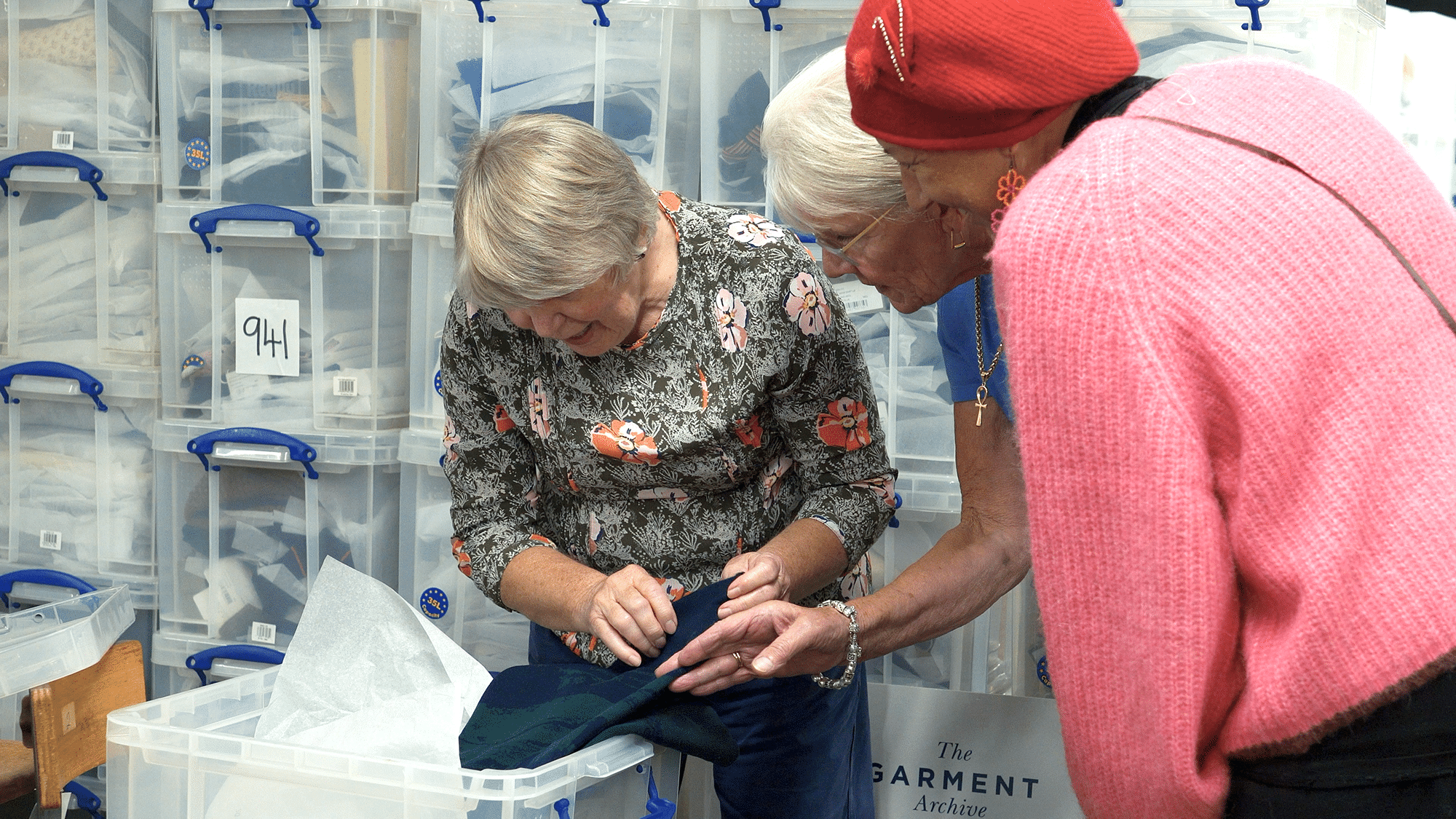
During my time as a volunteer, I’ve been able to gain a deeper understanding of the connections between my cottage industry craft hobby and the commercial manufacturing of wool and other fibre garments. I’ve been thoroughly privileged to learn about the work John, Tony and Iris have done over many years and it’s clear, when hearing accounts from all three, that there’s something special about working at Smedley’s. In my career, I was lucky enough to work in a large school - a warm and friendly place where the staff felt like family - and I get a similar feeling when I come into Smedley’s. I certainly hope modernity doesn’t allow that loyalty and compassion to get lost.